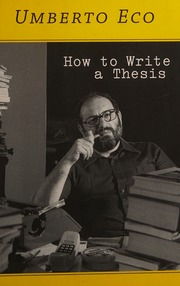
How to write a thesis
xxvi, 229 pages : 21 cm "Eco's approach is anything but dry and academic. He not only offers practical advice but also considers larger questions about the value of the thesis-writing exercise. How to Write a Thesis is unlike any other writing manual. It reads like a novel. It is opinionated. It is frequently irreverent, sometimes polemical, and often hilarious. Eco advises students how to avoid "thesis neurosis" and he answers the important question "Must You Read Books?" He reminds students "You are not Proust" and "Write everything that comes into your head, but only in the first draft." Of course, there was no Internet in 1977, but Eco's index card research system offers important lessons about critical thinking and information curating for students of today who may be burdened by Big Data."--Publisher's description Includes bibliographical references The definition and purpose of the thesis : What is a thesis and why is it required? ; For whom is this book written? ; The usefulness of a thesis after graduation ; Four obvious rules for choosing a thesis topic -- Choosing the topic : Monograph or survey? ; Historical or theoretical? ; Ancient or contemporary? ; How long does it take to write a thesis? ; Is it necessary to know foreign languages? ; "Scientific" or political? : What does it mean to be scientific? ; Writing about direct social experience ; Treating a "journalistic" topic with scientific accuracy ; How to avoid being exploited by your advisor -- Conducting research ; The availability of primary and secondary sources : What are the sources of a scientific work? ; Direct and indirect sources ; Bibliographical research : How to use the library ; Managing your sources with the bibliographic index card file ; Documentation guidelines ; An experiment in the library of Alessandria ; Must you read books?: If so, what should you read first? -- The work plan and the index card : The table of contents as a working hypothesis ; Index cards and notes : various types of index cards and their purpose ; Organizing the primary sources ; The importance of readings index cards ; Academic humility -- Writing the thesis : The audience ; How to write ; Quotations : When and how to quote: 10 rules ; Quotes, paraphrases, and plagiarism ; Footnotes : The purpose of footnotes ; The notes and bibliography system ; The author-date system ; Instructions, traps, and conventions ; Academic pride -- The final draft : Formatting the thesis : Margins and spaces ; Underlining and capitalization ; Sections ; Quotation marks and other signs ; Transliterations and diacritics ; Punctuation, foreign accents and abbreviations ; Some miscellaneous advice ; The final bibliography ; The appendices ; The table of contents -- Conclusions
نسخة ورقية
كتب أخرى

EAP 1268 Babad Diponegoro Vol. 1
These two volumes are the transliterations (romanized versions) of the two-volume Babad Dipanagara (autobiography of Prince Diponegoro of Yogyakarta, 1785-1855, leader of the Java War, 1825-30) published by Albert Rus...

Pharmacotherapy casebook : a patient-focused approach
xxi, 450 p. : 28 cm " 155 cases show you how apply the principles of pharmacotherapy to real-world clinical practice The perfect study companion to DiPiro's Pharmacotherapy: A Pathophysiologic Approach Pharmacotherapy...

John William Burgon, late Dean of Chichester : a biography, with extracts from his letters and early journals vol.1
John William Burgon, late Dean of Chichester : a biography, with extracts from his letters and early journals vol.1 — Goulburn, Edward Meyrick, 1818-1897

He Kaine Diatheke = The Greek Testament with English notes
588 p. ; 23 cm N.T. in Greek; notes in English Includes index United Bible Societies language: Greek: Ancient

The story of Doctor Dolittle, being the history of his peculiar life at home and astonishing adventures in foreign parts
6 p. . 180 p. 21 cm

The southern business directory and general commercial advertiser ..
Book digitized by Google from the library of Harvard University and uploaded to the Internet Archive by user tpb.