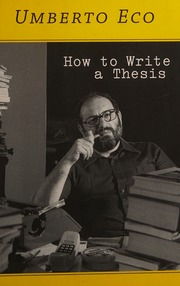
How to write a thesis
xxvi, 229 pages : 21 cm "Eco's approach is anything but dry and academic. He not only offers practical advice but also considers larger questions about the value of the thesis-writing exercise. How to Write a Thesis is unlike any other writing manual. It reads like a novel. It is opinionated. It is frequently irreverent, sometimes polemical, and often hilarious. Eco advises students how to avoid "thesis neurosis" and he answers the important question "Must You Read Books?" He reminds students "You are not Proust" and "Write everything that comes into your head, but only in the first draft." Of course, there was no Internet in 1977, but Eco's index card research system offers important lessons about critical thinking and information curating for students of today who may be burdened by Big Data."--Publisher's description Includes bibliographical references The definition and purpose of the thesis : What is a thesis and why is it required? ; For whom is this book written? ; The usefulness of a thesis after graduation ; Four obvious rules for choosing a thesis topic -- Choosing the topic : Monograph or survey? ; Historical or theoretical? ; Ancient or contemporary? ; How long does it take to write a thesis? ; Is it necessary to know foreign languages? ; "Scientific" or political? : What does it mean to be scientific? ; Writing about direct social experience ; Treating a "journalistic" topic with scientific accuracy ; How to avoid being exploited by your advisor -- Conducting research ; The availability of primary and secondary sources : What are the sources of a scientific work? ; Direct and indirect sources ; Bibliographical research : How to use the library ; Managing your sources with the bibliographic index card file ; Documentation guidelines ; An experiment in the library of Alessandria ; Must you read books?: If so, what should you read first? -- The work plan and the index card : The table of contents as a working hypothesis ; Index cards and notes : various types of index cards and their purpose ; Organizing the primary sources ; The importance of readings index cards ; Academic humility -- Writing the thesis : The audience ; How to write ; Quotations : When and how to quote: 10 rules ; Quotes, paraphrases, and plagiarism ; Footnotes : The purpose of footnotes ; The notes and bibliography system ; The author-date system ; Instructions, traps, and conventions ; Academic pride -- The final draft : Formatting the thesis : Margins and spaces ; Underlining and capitalization ; Sections ; Quotation marks and other signs ; Transliterations and diacritics ; Punctuation, foreign accents and abbreviations ; Some miscellaneous advice ; The final bibliography ; The appendices ; The table of contents -- Conclusions
Basılı kopya
Diğer Kitaplar

Feeling good : the new mood therapy
Includes bibliographical references (p. 688-691)and index In Feeling Good, eminent psychiatrist, David D. Burns, M.D., outlines the remarkable, scientifically proven techniques that will immediately lift your spirits ...

Monster : the autobiography of an L.A. gang member
Originally published: New York : Atlantic Monthly Press, 1993

Chaurapañchāśikā : a Sanskrit Love Lyric
Bilhaṇa, active 11th century. Reprint of 1967 ed. published by the National Museum, New Delhi Sanskrit erotic poetry with English translation and illustrations

Exploring The Dangerous Trades The Autobiography
Exploring The Dangerous Trades The Autobiography — Alice Hamilton

Color standards and color nomenclature
Twenty-seven colored samples mounted on each plate. "In the present work the possibility of variation between different copies is wholly eliminated ... Each color, for the entire edition, is painted uniformly on large...

CHAM WEIZMANN A BIOGRAPHY BY SEVERAL HANDS
CHAM WEIZMANN A BIOGRAPHY BY SEVERAL HANDS — MEYER W. WEISGAL, JOEL CARMICHAEL