
Half-real : video games between real rules and fictional worlds
ix, 233 pages : 24 cm "A video game is half-real: we play by real rules while imagining a fictional world. We win or lose the game in the real world, but we slay a dragon (for example) only in the world of the game. In this thought-provoking study, Jesper Juul examines the constantly evolving tension between rules and fiction in video games. Discussing games from Pong to The Legend of Zelda, from chess to Grand Theft Auto, he shows how video games are both a departure from and a development of traditional non-electronic games. The book combines perspectives from such fields as literary and film theory, computer science, psychology, economic game theory, and game studies to outline a theory of what video games are, how they work with the player, how they have developed historically, and why they are fun to play." "Locating video games in a history of games that goes back to Ancient Egypt, Juul argues that there is a basic affinity between games and computers. Just as the printing press and the cinema have promoted and enabled new kinds of storytelling, computers work as enablers of games, letting us play old games in new ways and allowing for new kinds of games that would not have been possible before computers. Juul presents a classic game model, which describes the traditional construction of games and points to possible future developments. He examines how rules provide challenges, learning, and enjoyment for players, and how a game cues the player into imagining its fictional world. Juul's lively style and eclectic deployment of sources will make Half-Real of interest to media, literature, and game scholars as well as to game professionals and gamers."--BOOK JACKET Includes bibliographical references (p. [203]-225) and index
physical copy
More Books

Compute! Magazine Issue 159
Compute! Issue 159 - December 1993. 50 great multimedia gift ideas (Multimedia PC) (Buyers Guide) (Column) - An end user's look at OS/2 2.1 (Personal Productivity) (Column) - Are they really learning? (software for ch...

Byte Magazine Volume 00 Number 01 - The Worlds Greatest Toy
Foreground
p.20 RECYCLING USED ICs
[theme Hardware] [author Mikkelsen]
p.62 DECIPHERING MYSTERY KEYBOARDS
[theme Hardware] [author Heltners]
p.72 LIFE Line
[theme Applications] [author Heltners]
Background
p.10 WHICH ...

Common Lisp: A Gentle Introduction to Symbolic Computation
Author's Site: https://www.cs.cmu.edu/~dst/LispBook/index.htmlThis highly accessible introduction to Lisp is suitable both for novices
approaching their first programming language and experienced
programmers interes...

Compute! Magazine Issue 065
Compute! Issue 65 - October 1985. Atari 520ST: A Hands-On Report - Amiga Goes IBM-Compatible - The New Games - Expert Systems: Shortcut to Artificial Intelligence? - The Witching Hour - Laser Beam for Atari and Commod...

Multispace & Multistructure. Neutrosophic Transdisciplinarity (100 Collected Papers of Sciences; Fourth Volume)
This is an eclectic tome of 100 papers in various fields of sciences, alphabetically listed, such as: astronomy, biology, calculus, chemistry, computer programming codification, economics and business and politics, ed...
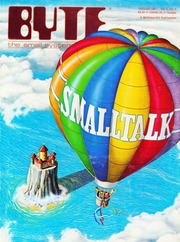
Byte Magazine Volume 06 Number 08 - Smalltalk
Features
p.14 introducing the Smalltalk-80 System
[author Adele Goldberg]
A readers' guide to the Smalltalk articles in this issue.
p.36 The Smalltalk-80 System
[author the Xerox Learning Research Group]
How message-s...