
Biblical Translation - Does the Revised Version of Westcott Hort Change the Word Meanings of the New Testament (AV - KJV) ?
Biblical Translation - Does the Revised Version of Westcott-Hort Change the Word Meanings of the New Testament (AV - KJV) ?
The original title of this is âDoes the Revised Version affect the Teachings of the New Testamentâ, an âobviousâ title, IF you are among those who lived 100 years ago. The question that this author is asking, is: what is the impact of Westcott and Hort on the actual words and meaning of the New Testament, through the release of their version of the Bible ?
The Revised Version was released around 1881/1882 by a group of translators who were nominally Anglican. However the Revised Version is largely perceived as having opened the floodgates to weak, inaccurate and misleading translations of the Biblical Text. That assessment is disputed, almost always by those who a-priori, are opposed to any conclusion that the Old and New Testaments might actually be the Word of God. To claim to be âsearchingâ for answers is allowed, but to actually claim to have found answers, well that is not so politically correct. The original translators of the New Testament believed in the text they were translating, and in its supernatural origins (according to the work of E. Henderson and Robert Haldane, Munro, Calvin, Robert Wilson, etc).
But modern translators are a very different group, who have undertaken the translation of Christian texts as resume enhancers or as a means to obtain tenure. The result is that those who take college courses on Christianity find themselves barraged by critics who were hired on the basis of their rejection of the Christian faith they would claim to educate others about. Christianity seems to be the main religion where this takes place. Buddhism should be taught by Buddhists, Islam may be taught by a Moslem. Why is Christianity treated to a different standard, where confusion is often the result, especially to sincere or seeking students ?
Keep in mind that to challenge the new othodoxy of underming of Christianity would cause worries to countless philosophy departments, seminary professors, and publishers who have made not a few dollars claiming that they had the newest âsecretâ of Christianity, the secret teachings of Jesus, a picture of the wood of the cross, the veil of Mary, etc. Thurcaston makes the effort to look at the translation of Westcott and Hort and compare it with the Greek New Testament, in order to evaluate the results. Keep in mind that Westcott and Hort released BOTH an English-Language version of their text, as well as a Greek Text version (which was their own greek collation based largely on Vaticanus). The version of Westcott-Hort in England was called the Revised Version. In the USA, the Westcott-Hort version was withheld from publication until 1901, when it was released as the ASV, the American Standard Version. Burgon, FHA Scrivener and many others took Westcott and Hort to task for actually substituting their own changed and altered New Greek text, in place of the standard Greek text which had been used by the historic church for 2000 years. Since that time, there are multitudes of versions of the New Testament, and many people have found the new versions confusing and un-clear. There are a few new versions such as that of Jay Green, but that is based on the ancient historic Greek text [T.R.] used by the Byzantine and historical Evangelical churches.
The Bible Societies split on this question of which text to use. In 1904 the BFBS, agreed to stop using the Historic Greek Text for the New Testament, and to substitute a new Hybrid, the version of Nestle. Nestle based his version on Westcott and Hort, and also on the changed text of Tischendorf, who had decided to adopt Codex Sinaiticus, part of the same family of rejected texts as Codex Vaticanus. [Hoskier did a line-by-line comparison between Codex Vaticanus and Sinaiticus in his work âCodex B and its Alliesâ, which was released in 1914 (available online).
.
physical copy
More Books

al-Dirāsah al-taḥlīlīyah li-Kitāb al-Ṭibb al-rūḥānī
300, 36 pages : facsimiles ; 25 cm. Includes bibliographical references
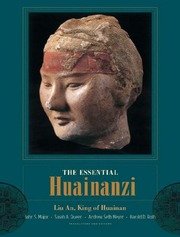
The Essential Huainanzi
The Essential Huainanzi (an abridged version of the longer work), a collection of teachings from Daoist masters based on debates organized by Liu An, the King of Huainan, is available here in EPUB, AZW3, and PDF forma...

Athena : grey-eyed goddess
76 pages : 26 cm From the moment she emerged, fully grown, from the head of Zeus, Athena was one of the most complex Olympians. This graphic novel retells her many interwoven tales: how she killed Pallas, fought the G...

دار الكتب المصرية تاريخها وتطورها
دار الكتب المصرية : تاريخها وتطورهاتأليف : أيمن فؤاد سيدالناشر : الهيئة المصرية العامة للكتابالطبعة الأولىسنة النشر : 2005
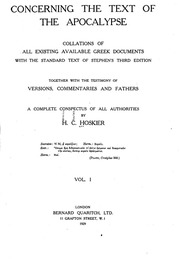
Hoskier - Concerning the Text of the Apokalypse
Collations of all existing available Greek documents, plus versions, commentaries and fathers
Both volumes in one PDF, 1465 pages, 1929.

CIA Documents
CIA Document Collection